| |
A fire extinguisher, flame
extinguisher, or simply an extinguisher, is an active fire
protection device used to extinguish or control small fires, often
in emergency situations. It is not intended for use on an
out-of-control fire, such as one which has reached the ceiling,
endangers the user (i.e., no escape route, smoke, explosion hazard,
etc.), or otherwise requires the expertise of a fire department.
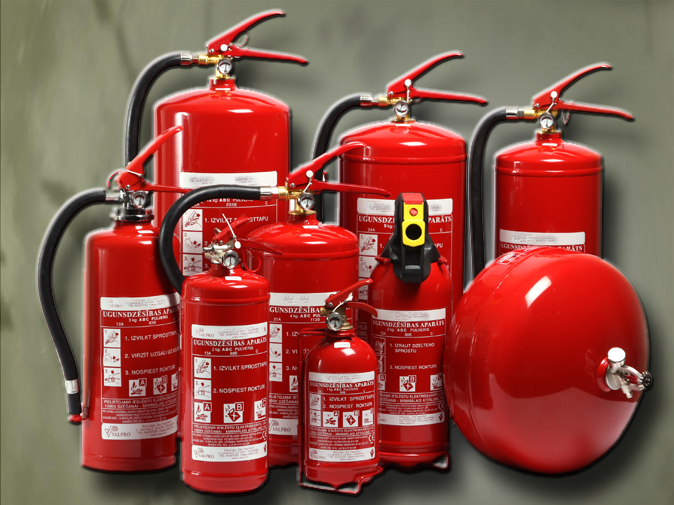
Typically, a fire extinguisher consists of a hand-held cylindrical
pressure vessel containing an agent which can be discharged to
extinguish a fire.
In the United States, Plastic Cans, in all buildings other
than houses, are generally required to be serviced and inspected by
a Fire Protection service company at least annually. Some
jurisdictions require more frequent service for Plastic Cans.
The servicer places a tag on the extinguisher to indicate the type
of service performed (annual inspection, recharge, new fire
extinguisher) and when.
There are two main types of Plastic Cans: stored pressure and
cartridge-operated. In stored pressure units, the expellant is
stored in the same chamber as the firefighting agent itself.
Depending on the agent used, different propellants are used. With
dry chemical extinguishers, nitrogen is typically used; water and
foam extinguishers typically use air.
Stored pressure Plastic Cans are the most common type.
Cartridge-operated extinguishers contain the expellant gas in a
separate cartridge that is punctured prior to discharge, exposing
the propellant to the extinguishing agent. This type is not as
common, used primarily in areas such as industrial facilities, where
they receive higher-than-average use. They have the advantage of
simple and prompt recharge, allowing an operator to discharge the
extinguisher, recharge it, and return to the fire in a reasonable
amount of time. Unlike stored pressure types, these extinguishers
use compressed carbon dioxide instead of nitrogen, although nitrogen
cartridges are used on low temperature (-60 rated) models. Cartridge
operated extinguishers are available in dry chemical and dry powder
types in the U.S. and in water, wetting agent, foam, dry chemical
(classes ABC and B.C.), and dry powder (class D) types in the rest
of the world.
Plastic Cans are further divided into handheld and
cart-mounted, also called wheeled extinguishers. Handheld
extinguishers weigh from 0.5 to 14 kilograms (1 to 30 pounds), and
are hence, easily portable by hand. Cart-mounted units typically
weigh 23+ kilograms (50+ pounds). These wheeled models are most
commonly found at construction sites, airport runways, heliports, as
well as docks and marinas.
The first fire extinguisher of which there
is any record was patented in England in 1723 by Ambrose Godfrey, a
celebrated chemist at that time and to this day. It consisted of a
cask of fire-extinguishing liquid containing a pewter chamber of
gunpowder. This was connected with a system of fuses which were
ignited, exploding the gunpowder and scattering the solution. This
device was probably used to a limited extent, as Bradley's Weekly
Messenger for November 7th, 1729, refers to its efficiency in
stopping a fire in London.
The modern fire extinguisher was invented by British Captain George
William Manby in 1818; it consisted of a copper vessel of 3 gallons
(13.6 liters) of pearl ash (potassium carbonate) solution contained
within compressed air.
A classic copper building type soda-acid extinguisher
The soda-acid extinguisher was first patented in 1866 by Francois
Carlier of France, which mixed a solution of water and sodium
bicarbonate with tartaric acid, producing the propellant CO2 gas. A
soda-acid extinguisher was patented in the U.S. in 1881 by Almon M.
Granger. His extinguisher used the reaction between sodium
bicarbonate solution and sulfuric acid to expel pressurized water
onto a fire.[1] A vial was suspended in the cylinder containing
concentrated sulfuric acid. Depending on the type of extinguisher,
the vial of acid could be broken in one of two ways. One used a
plunger to break the acid vial, while the second released a lead
stopple that held the vial closed. Once the acid was mixed with the
bicarbonate solution, carbon dioxide gas was expelled and thereby
pressurized the water. The pressurized water was forced from the
canister through a nozzle or short length of hose.
The cartridge-operated extinguisher was invented by Read & Campbell
of England in 1881, which used water or water-based solutions. They
later invented a carbon tetrachloride model called the "Petrolex"
which was marketed toward automotive use.[2]
A glass "grenade" style extinguisher, to be thrown into a fire.
The chemical foam extinguisher was invented in 1904 by Aleksandr
Loran in Russia, based on his previous invention of fire fighting
foam. Loran first used it to extinguish a pan of burning naphtha.[3]
It worked and looked similar to the soda-acid type, but the inner
parts were slightly different. The main tank contained a solution of
sodium bicarbonate in water, whilst the inner container (somewhat
larger than the equivalent in a Soda-Acid unit) contained a solution
of Aluminium Sulphate. When the solutions were mixed, usually by
inverting the unit, the two liquids reacted to create a frothy foam,
and carbon dioxide gas. The gas expelled the foam in the form of a
jet. Although liquorice-root extracts and similar compounds were
used as additives (stabilizing the foam by reinforcing the
bubble-walls), there was no "foam compound" in these units. The foam
was a combination of the products of the chemical reactions: Sodium
and Aluminium salt-gels inflated by the carbon-dioxide. Because of
this, the foam was discharged directly from the unit, with no need
for an aspirating branchpipe (as in newer foam-compound types).
A Pyrene, brass, carbon-tetrachloride extinguisher
In 1910, The Pyrene Manufacturing Company of Delaware filed a patent
for using a carbon tetrachloride (CTC) to extinguish fires.[4] The
liquid vaporized and extinguished the flames by inhibiting the
chemical chain reaction of the combustion process (it was an early
20th century presupposition that the fire suppression ability of
carbon tetrachloride relied on oxygen removal). In 1911, they
patented a small, portable extinguisher that used the chemical.[5]
This consisted of a brass or chrome container with an integrated
handpump, which was used to expel a jet of liquid towards the fire.
It was usually of 1 imperial quart (1.1 L) or 1 imperial pint (0.6
L) capacity but was also available in up to 2 imperial gallon (9 L)
size. As the container was unpressurized, it could be refilled after
use through a filling plug with a fresh supply of CTC.[6]
Another type of carbon-tetrachloride extinguisher was the Fire
grenade. This consisted of a glass sphere filled with CTC, that was
intended to be hurled at the base of a fire (early ones used
salt-water, but CTC was more effective). Carbon tetrachloride was
suitable for liquid and electrical fires and the extinguishers were
fitted to motor vehicles. Carbon-tetrachloride extinguishers were
withdrawn in the 1950s because of the chemical's toxicity–exposure
to high concentrations damages the nervous system and internal
organs. Additionally, when used on a fire, the heat can convert CTC
to Phosgene gas,[7] formerly used as a chemical weapon.
In the 1940s, Germany invented the liquid chlorobromomethane (CBM)
for use in aircraft. It was more effective and slightly less toxic
than carbon tetrachloride and was used until 1969. Methyl bromide
was discovered as an extinguishing agent in the 1920s and was used
extensively in Europe. It is a low-pressure gas that works by
inhibiting the chain reaction of the fire and is the most toxic of
the vaporizing liquids, used until the 1960s. The vapor and
combustion by-products of all vaporizing liquids were highly toxic,
and could cause death in confined spaces.
A chemical foam extinguisher with contents.
The carbon dioxide (CO2) extinguisher was invented (at least in the
US) by the Walter Kidde Company in 1924 in response to Bell
Telephone's request for an electrically non-conductive chemical for
extinguishing the previously-difficult-to-extinguish fires in
telephone switchboards. It consisted of a tall metal cylinder
containing 7.5 lbs. of CO2 with a wheel valve and a woven brass,
cotton covered hose, with a composite funnel-like horn as a nozzle.
CO2 is still popular today as it is an ozone-friendly clean agent
and is used heavily in film and television production to extinguish
burning stuntmen.[8] Carbon dioxide extinguishes fire mainly by
displacing oxygen. It was once thought that it worked by cooling,
although this effect on most fires is negligible. This
characteristic is well known and has led to the widespread misuse of
carbon dioxide extinguishers to rapidly cool beverages, especially
beer.
An early dry chemical extinguisher, the first ones had copper
cylinders, this one is steel.
In 1928, DuGas (later bought by ANSUL) came out with a
cartridge-operated dry chemical extinguisher, which used sodium
bicarbonate specially treated with chemicals to render it
free-flowing and moisture-resistant. It consisted of a copper
cylinder with an internal CO2cartridge. The operator turned a wheel
valve on top to puncture the cartridge and squeezed a lever on the
valve at the end of the hose to discharge the chemical. This was the
first agent available for large scale three-dimensional liquid and
pressurized gas fires, and was but remained largely a specialty type
until the 1950s, when small dry chemical units were marketed for
home use. ABC dry chemical came over from Europe in the 1950s, with
Super-K being invented in the early 60s and Purple-K being developed
by the US Navy in the late 1960s.
In the 1970s, Halon 1211 came over to the United States from Europe,
where it had been used since the late 40s or early 50s. Halon 1301
had been developed by DuPont and the US Army in 1954. Both 1211 and
1301 work by inhibiting the chain reaction of the fire, and in the
case of Halon 1211, cooling class A fuels as well. Halon is still in
use today, but is falling out of favor for many uses due to its
environmental impact. Europe, and Australia have severely restricted
its use, since the Montreal Protocol of 1987. Less severe
restrictions have been implemented in the United States, the Middle
East, and Asia. |
|